

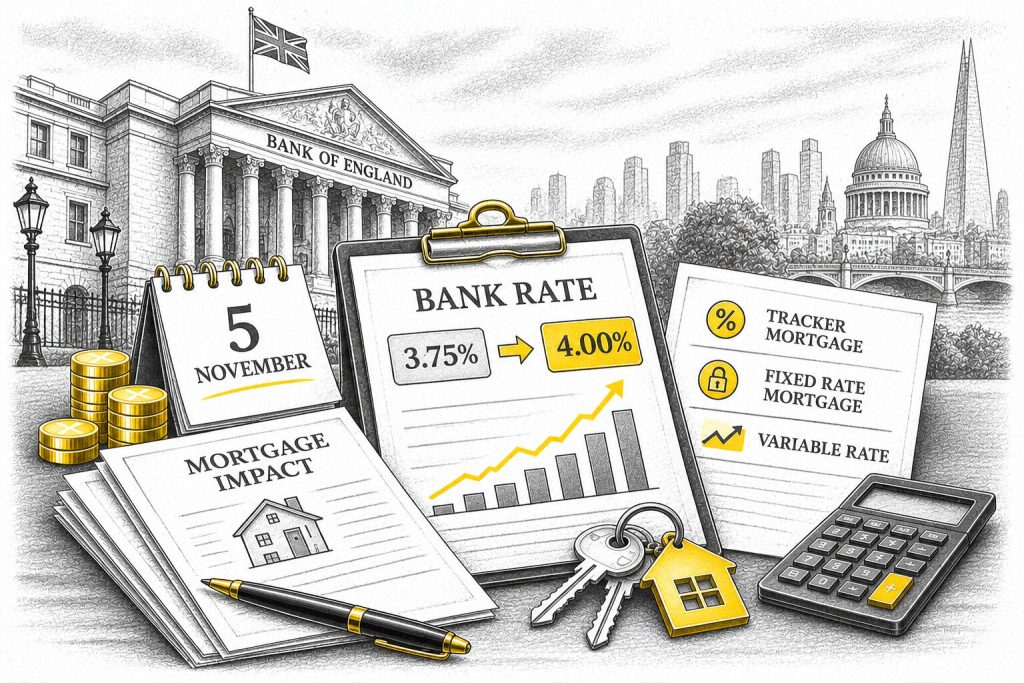
Quick answer: The Bank of England raised Bank Rate from 3.75% to 4% on 5 November. If you are on a tracker or standard variable rate, your payments will rise. If you are on a fixed rate, your payments do not change until your deal ends. Fixed rates for new deals had already risen ahead of the decision, so if your deal ends within six months it is worth reviewing your options now.
What the Bank decided
At its meeting on 5 November, the Bank of England’s Monetary Policy Committee voted 8 to 1 to raise Bank Rate by 0.25 percentage points, from 3.75% to 4%. It is the first increase since August 2023. One member voted for a larger rise of 0.5 percentage points, to 4.25%. The Committee said the scale and duration of the rise in energy prices, linked to the conflict in the Middle East, had created enough inflationary pressure in the pipeline to warrant an increase, and that activity had been stronger than expected. CPI inflation was 3.5% in September, well above the Bank’s 2% target, and the Bank now expects it to rise to around 5% by the middle of next year before falling back. The Committee also said monetary policy is not on a pre-set path and that it will assess the evidence at each meeting.
Why fixed mortgage rates moved before the decision
Fixed mortgage rates are priced off swap rates, which reflect what markets expect Bank Rate to do over the coming years, not off today’s Bank Rate directly. When a rate change is widely expected, it is largely in the price before the announcement. As at 2 November, Moneyfacts put the average two-year fixed rate at 5.97% and the average five-year fixed rate at 6.00%, both higher than a month earlier.
What it means for your mortgage
- Tracker and variable rate: payments follow Bank Rate changes within a few weeks. As an illustration, for every 0.25 percentage point change in Bank Rate, a borrower with £200,000 outstanding over 25 years on a repayment basis sees their payment move by about £29 a month.
- Fixed rate: your payment does not change until the deal ends, whatever Bank Rate does in the meantime. What matters is the rate available when it does.
- Standard variable rate: if you have drifted onto your lender’s standard variable rate, the average stands at 7.13% (Moneyfacts, 2 November), so it is rarely the best place to stay.
- Deal ending within six months: most lenders let you secure a new rate up to six months ahead at no cost, and you can usually switch if something better appears before you complete.
- Buying or moving: lenders test whether you could afford your payments at higher rates, so rising rates can reduce how much you can borrow even before your own rate changes.
What to do now
Nobody can say with certainty where rates go from here, and a single decision does not settle it. The practical step is the same whatever happens next: find out when your current deal ends, check whether there is an early repayment charge, and review the options while you still have time. At London FS we look at the whole picture before recommending a product, including how long you plan to stay and whether a shorter or longer fix suits you.
| Bank Rate raised from 3.75% to 4% on 5 November 2026, by 8 votes to 1. It had been held on 17 September, by 6 votes to 3. CPI inflation 3.5% in September (ONS). Average two-year fixed 5.97%, average five-year fixed 6.00%, average two-year variable 4.68%, average standard variable rate 7.13% (Moneyfacts, as at 2 November 2026). |
Frequently asked questions
No. A fixed rate stays the same until the fixed period ends. What changes is the rate you would be offered for your next deal.
Tracker mortgages follow Bank Rate, usually within a few weeks of a decision, depending on your lender’s terms.
It depends on your circumstances, how long you plan to stay in the property and how comfortable you are with a payment that could change. That is a conversation to have with an adviser before you decide.
Most lenders let you secure a rate up to six months before your current deal ends, and some offers last up to 12 months.
This is general information and not personal advice. Your home may be repossessed if you do not keep up repayments on your mortgage. Outcomes depend on individual circumstances and lender criteria.
Sources: Bank of England, Monetary Policy Summary and minutes, 5 November 2026; Bank of England decision of 17 September 2026 and vote, as reported by MTS Insights; ONS, Consumer price inflation, UK: September 2026 (21 October 2026); Moneyfacts average rates as at 2 November 2026, as reported by Forbes Advisor UK; HomeOwners Alliance, interest rate predictions (updated 2 November 2026), citing a Reuters poll of 63 economists. London FS illustration: £200,000 repayment mortgage over 25 years, payment at 4.68% compared with 4.93%, rounded.