


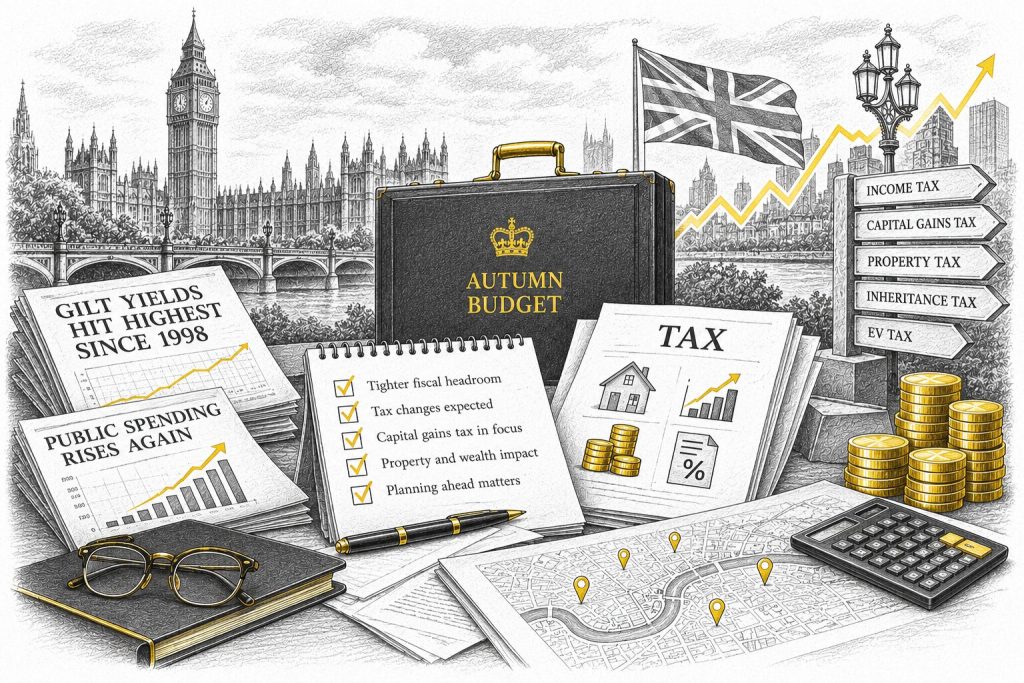
This isn’t a Liz Truss moment. It’s a slower one and slower doesn’t mean safer.
Liz Truss lasted 49 days as Prime Minister and we still talk about her mini-Budget like it was a natural disaster. Thirty year gilt yields spiked over a hundred basis points in three trading days and the Bank of England had to step in to stop pension funds imploding. That episode became shorthand for an entire category of mistake: don’t spook the bond market. Few politicians manage to turn their tenure into a unit of economic measurement, but here we are.
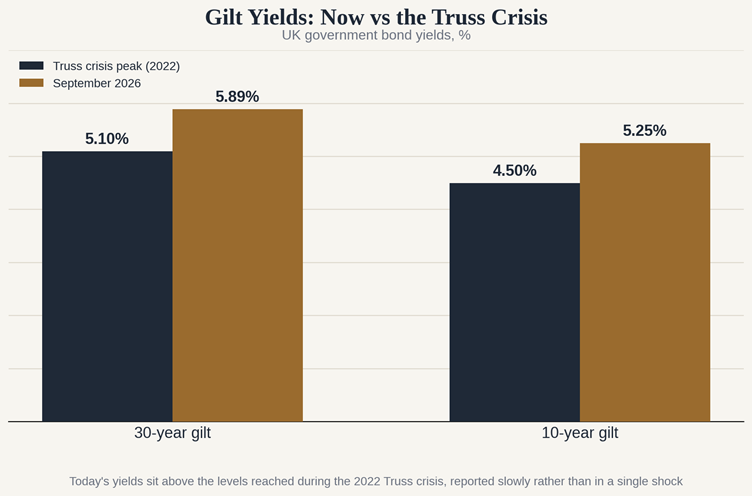
Here’s the bit that doesn’t get said enough in the run-up to this year’s Autumn Budget. Thirty year gilt yields hit 5.89% in early September 2026. That’s the highest level since 1998 and it sits comfortably above the peak reached during the Truss crisis. Ten year yields pushed above 5.2% as well, a level not seen since 2008. Nobody’s panicking the way they did in 2022 and that’s really the only difference between then and now. As deVere Group’s Nigel Green put it, Britain is being “slowly Truss’d” the same underlying story stretched out over a year instead of a week, which makes it easier to ignore in the moment and much harder to unwind later.
A slow motion car crash is still a car crash. It’s just one where everyone involved has had more time to look busy while it happens.
Where the numbers actually stand
Total Managed Expenditure is the official measure of what government spends and it stood at £1,230.7 billion in 2023/24, the last full financial year before the 2024 election. By 2024/25 that figure had risen to £1,290.6 billion, and both numbers come straight from HM Treasury’s own published statistics. Independent estimates for 2025/26 put the figure at around £1,323.8 billion, which would mean roughly £93 billion of extra annual spending across two years once that number is confirmed.
Debt interest alone now accounts for close to 10% of the entire budget, up from around 5% back in 2018/19 and public debt is closing in on 100% of GDP.
Growth tells a more mixed story than either side of the political debate tends to admit. On the government’s own preferred measure of GDP per capita, the UK had the highest growth in the G7 for one quarter, Q1 2025 but hasn’t repeated that result since and independent trackers now rate that specific manifesto commitment as off track for exactly that reason. One strong quarter doesn’t make a trend.
Separately, the UK also recorded the highest overall GDP growth in the G7 during Q1 2026, which is a different measure entirely and a reminder that the picture here is genuinely mixed rather than simply bad news dressed up as something else.
What to actually expect from 28 October
Chancellor John Healey delivers his first Budget on 28 October and the fiscal arithmetic has tightened noticeably since the spring. KPMG estimates headroom against the government’s own fiscal rules has fallen from around £23.6 billion in March to roughly £12 billion now, driven largely by rising borrowing costs and a weaker growth outlook. Something has to give somewhere!
What’s firmly off the table are rises to the headline rates of income tax, employee National Insurance and VAT. The Chancellor has repeatedly committed to holding that line and breaking it now would carry a real political cost. Rule out the three biggest levers in the toolbox and you’ve simply guaranteed that whatever replaces them will need to work a great deal harder.
What’s genuinely on the table is a lot more interesting. This would be Labour’s third consecutive tax raising Budget after £41.5 billion in October 2024 and £26 billion in November 2025.
Expect close scrutiny of capital gains tax, where alignment with income tax rates is being described as the front runner option, alongside growing pressure to raise bank taxation and a long trailed change to how electric vehicles are taxed through a mileage based charge that replaces lost fuel duty revenue.
Several commentators are also expecting this to be a quieter and more technical Budget than recent years, built around consultations and roadmaps rather than one single dramatic announcement, with at least some attempt to show modest spending restraint alongside the tax measures.
Why this matters beyond the headlines
None of this is abstract if you’re a business owner, a company director or anyone whose wealth sits in property, investments or pensions rather than a standard PAYE salary. Budgets built around capital and property tend to land hardest on exactly that group and the real planning window sits in the gap between “headroom is tight” and “specific policy announced” not after the announcement itself.
For foreign national and high net worth clients specifically, this Budget arrives at an unusual moment. The old non-dom regime is already gone, replaced by the residence based system that took effect in April 2025, so this won’t be the Budget that reopens that particular debate. What it could do instead is tighten the edges around it.
Further detail on how trusts and inheritance tax interact for long term residents is still being worked through ahead of the 2026/27 tax year and anyone holding prime London property should treat the mansion tax threshold as genuinely live rather than settled given the reported £1.5 million option under active consideration.
If you’re structuring a purchase, a refinance or cross border wealth around this Budget, the sensible approach is the one we’d give any client in this position: don’t wait for the announcement to find out whether it affects you, and model both the £2 million and £1.5 million scenarios now while there’s still time to act on whichever one lands.
There’s also a deferral scheme attached to this tax that’s worth understanding properly, because it sounds more useful to our clients than it actually is. The government has confirmed that homeowners who cannot afford the charge will be able to defer payment until the property is sold or until death, with the debt secured against the property and interest accruing in the meantime at roughly HMRC’s standard late payment rate. On paper that looks like a safety net. In practice it’s only available on your main home, not a second property or anything held in a company and eligibility is means tested against income and savings thresholds reportedly as low as £35,000 and £16,000.
Most clients reading this will not qualify for deferral at all. For this audience the realistic planning assumption should be that the charge gets paid annually in cash, not deferred against the estate, and any inheritance or estate planning should be built around that assumption rather than hoping the deferral route will be available.
Whatever actually lands on 28 October, it’s worth having reviewed your position well before the Budget rather than scrambling to react to it afterwards. Governments get to change the rules whenever they like. The rest of us just have to be ready when they do.
Sources: Office for National Statistics; HM Treasury Public Spending Statistics (May 2026 release); OBR; Full Fact Government Tracker; Financial Mirror; Grant Thornton, BDO, PKF Francis Clark and KPMG Autumn Budget 2026 previews; Tax Policy Associates.