

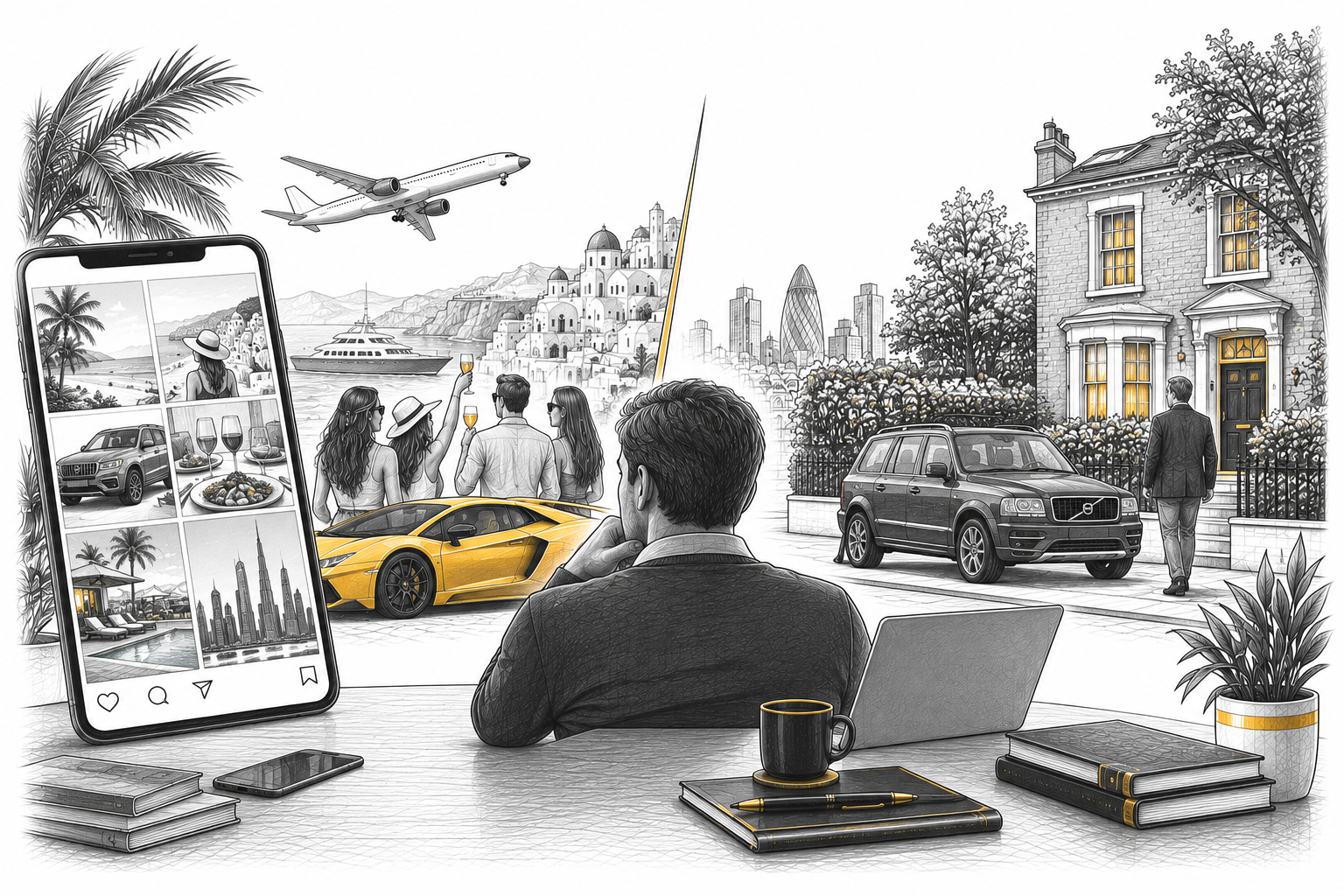
I’ve met genuinely wealthy people who drive a ten-year-old Volvo. I’ve also met people with £40,000 of credit card debt who’ve just come back from Dubai for the third time this year. If you tried to guess which was which from their Instagram, you’d almost certainly get it backwards. That gap, between how rich someone looks and how rich someone actually is, has quietly become one of the biggest drivers of financial stress I see, and it barely gets talked about honestly.
Keeping up with the Joneses isn’t new. Every generation has had some version of it. What’s different now is the scale and the speed. It used to be that you found out your neighbour bought a new car when you saw it on the drive. Now you find out forty people bought a new car, went on holiday, renovated a kitchen and started a side hustle, all before you’ve finished your coffee, and all of it curated to look effortless. The comparison isn’t occasional anymore. It’s constant, and it’s designed to be.
This isn’t really about vanity
It would be easy to write this off as people being shallow or bad with money, but I don’t think that’s fair, and I don’t think it’s accurate. Spending to keep pace with a perceived standard isn’t really about vanity, it’s about belonging. Nobody wants to be the one friend who didn’t go on the trip, or the colleague whose kitchen still looks like it did in 2015. That pressure is genuinely social, and social pressure is a powerful enough force to override sound financial judgement in people who are, in every other part of their life, entirely sensible.
The trouble is that lifestyle spending is contagious in a way that saving simply isn’t. Nobody posts a photo of their pension contribution going up by two percent. Nobody shows you the boring version of financial stability: the same car for longer than feels exciting, the holiday that’s genuinely within budget, the fact that most of their money is doing something useful rather than something photogenic. So the comparison you’re making is never a fair one. You’re comparing your actual financial position to everyone else’s highlight reel, and the highlight reel always wins, because it’s the only thing on display.
Where this actually leads
I’ve sat with clients whose income looks, on paper, extremely healthy, and whose actual financial position is far more fragile than that income suggests. Not because they’re reckless, but because a certain lifestyle became the baseline expectation before anyone stopped to ask whether it should be. Once a standard of living becomes normal, dropping below it feels like failure, even if the standard itself was never sustainable in the first place. That’s how people end up asset rich and cash constrained: plenty of value tied up somewhere, very little actually available when it’s needed.
The bit that changes everything
Here’s where I think perspective genuinely does the work that budgeting advice can’t. The people I know who are least affected by all of this aren’t the ones with the most money, they’re the ones who’ve stopped measuring themselves against a moving target set by other people’s curated lives. They’ve quietly decided what “enough” looks like for them, specifically, and they’re no longer negotiating that number against a stranger’s holiday photos.
That’s not a financial skill. It’s closer to a decision. And it tends to be the people who make that decision early who end up in the strongest financial position later, not because they earned more, but because they stopped spending to compete with people whose actual numbers they never saw in the first place. Being rich and looking rich have never been the same thing. The sooner that stops feeling like a consolation and starts feeling like the whole point, the better most people’s finances tend to look.
#FinancialWellbeing #MoneyMindset #PersonalFinanceUK #LifestyleCreep #WealthVsIncome #FinancialFreedomUK #UKFinance #MoneyTalk #FinancialPlanningUK #InstagramVsReality