

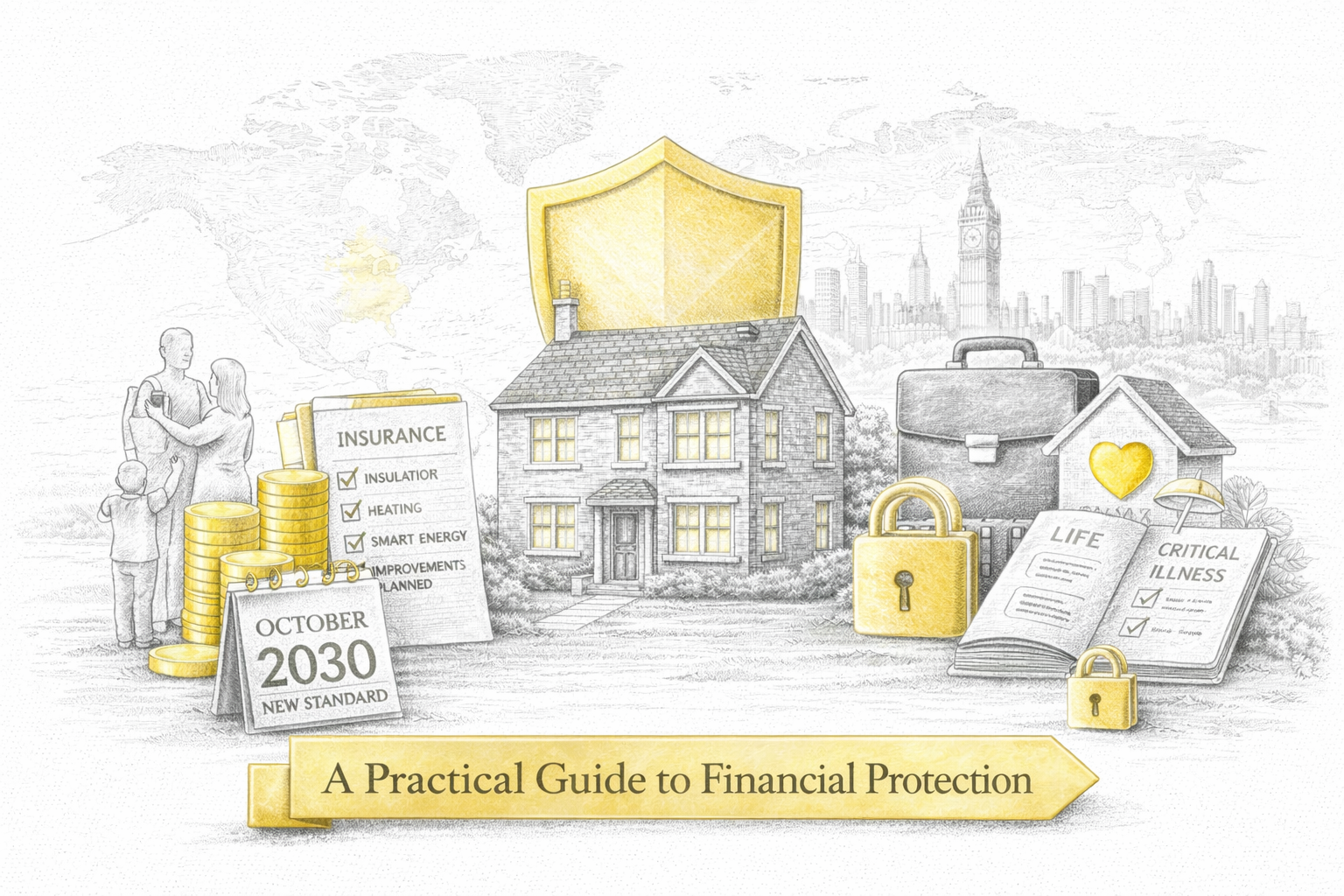
Protecting your income, your home and the people who rely on you
Most people spend years building a life: a home, savings, a business, a family routine, plans for the future. What often gets less attention is what happens if that routine is suddenly interrupted.
That is where financial protection comes in.
At London FS, we see protection as one of the most important parts of financial planning. It is not there to make you wealthier. It is there to stop everything you have built from coming under pressure if life takes an unexpected turn. Illness, loss of income, serious diagnosis or death can have a financial impact long before people have had time to emotionally process what is happening.
A well-structured protection plan is there to reduce that pressure. It can help keep the mortgage paid, the household running and the wider plan intact while you or your family deal with more important things.
What do we mean by financial protection?
Financial protection is the umbrella term for the policies designed to support you or your family if your health, income or life circumstances change unexpectedly.
In simple terms, it is the part of your financial plan that answers questions such as:
What happens if I cannot work for six months?
How would the mortgage be paid if I became seriously ill?
Would my family be financially secure if I died too soon?
Would there be enough in place to cover childcare, school fees, rent, bills or business commitments?
For some people, the key concern is replacing income. For others, it is making sure a lump sum is available if they are diagnosed with a serious illness. For business owners, it may be about protecting the company as much as the household.
The right answer depends on what you are protecting and who would feel the financial impact if you were not able to earn, work or make decisions as normal.
Why this matters more than many people realise
People often assume they have more protection than they actually do.
Some rely on employer benefits without checking how long they last. Others assume Statutory Sick Pay would cover enough, when in reality it is very limited and only intended as a basic level of support. As things stand, SSP is published at £118.75 a week for 2025/26, rising to £123.25 a week or 80% of average weekly earnings, whichever is lower, from 6 April 2026, and it is generally payable for up to 28 weeks. For most households, that is nowhere near enough to comfortably cover mortgage payments, household bills and day-to-day living costs.
That gap is where protection planning becomes so important.
Done properly, protection can help you:
- keep up with mortgage or rent payments
- cover regular monthly commitments
- avoid relying heavily on savings
- reduce the risk of debt building up during illness
- protect your partner, children or dependants
- give yourself breathing space at an already stressful time
At its core, protection is about keeping the roof over your head and preserving financial stability when life is not going to plan.
What should you be protecting?
Before looking at products, it helps to look at what is actually at risk.
For most people, the main areas are:
- your income
- your mortgage or rent
- your household bills and living costs
- your partner or dependants
- your future plans, such as education costs or retirement savings
- your business, if others rely on you
This is why protection should never be treated as a box-ticking exercise. It needs to reflect your real life. A single applicant with no dependants may need something very different from a family with children, a large mortgage and one main earner. Likewise, a self-employed business owner may have a far greater need for income protection than someone with a very generous employer benefits package.
How much cover is enough?
There is no universal figure. The starting point is to understand the gap that would appear if your income stopped or a serious illness created additional costs.
Usually, that means looking at:
- your essential monthly spending
- your mortgage, rent and regular bills
- any school fees, childcare or maintenance commitments
- whether a partner could maintain the household alone
- existing savings and how long they would realistically last
- any death-in-service or employer protection benefits already in place
You also need to think about timescale. Are you trying to cover a short-term shock, the full mortgage term, the years until children become financially independent, or the longer-term impact of losing one partner’s income permanently?
Good protection advice is not about selling the biggest number. It is about working out what would genuinely make the position manageable.
Income protection
Cover designed to support your earnings if illness stops you working
Income protection is one of the most valuable types of cover, yet it is often the most overlooked.
Its purpose is straightforward: if you are unable to work due to illness or injury, the policy can pay a regular monthly benefit to help replace part of your income. Policies usually insure a percentage of earnings rather than your full salary, and the payments can continue until you return to work, reach the end of the policy term, or retire, depending on how the plan is set up.
This type of cover can be particularly important if:
you are self-employed
you are a contractor or company director
you rely heavily on bonuses or variable income
your employer sick pay is limited
your household depends on your earnings
A key part of income protection is the deferred period. This is the waiting time between stopping work and the policy starting to pay. A longer deferred period usually means lower premiums, but it also means you need to be confident you can bridge that gap using savings or employer benefits.
Another important point is the definition of incapacity. “Own occupation” cover is usually the strongest form, as it looks at whether you can do your actual job rather than any job at all. That distinction matters.
Income protection does not normally pay out for redundancy, and it has no cash-in value if you never claim. But where it is set up well, it can be one of the most important financial foundations a household has.
Critical illness cover
A lump sum if you are diagnosed with a serious condition covered by the policy
Critical illness cover is designed to pay a lump sum if you are diagnosed with a specified serious medical condition during the policy term.
This is different from income protection. Instead of paying monthly, it provides a one-off payment that can be used however it is needed: reducing the mortgage, funding time away from work, adapting the home, paying for care, or simply creating breathing space.
Most policies are built around defined serious conditions and often include core illnesses such as cancer, heart attack and stroke, but the exact wording matters. Not every condition is covered, and not every stage or severity of illness will qualify. Many policies also include a survival period, often around 10 to 14 days, meaning the claimant usually needs to survive for that period after diagnosis to receive the benefit.
Critical illness cover can be particularly useful where a family would need a lump sum rather than a monthly income. For example, if the priority is clearing or reducing a mortgage balance, making up for a long recovery period, or protecting capital during treatment.
It is also common to use critical illness cover alongside income protection rather than instead of it. One deals with the shock of a major diagnosis through a lump sum. The other helps with ongoing income if you cannot work.
Life cover
Financial support for the people left behind
Life cover is there to provide money to your chosen beneficiaries if you die during the policy term.
For many families, this is the simplest and clearest form of protection. If one person’s income supports the household, the financial effect of their death can be immediate and significant. Life cover can help repay a mortgage, replace lost income, support children, cover funeral costs and provide time for the family to adjust without making rushed financial decisions.
There are different ways to arrange it.
Level term cover provides a fixed payout for a chosen number of years.
Decreasing term cover is often used alongside a repayment mortgage because the sum insured reduces broadly in line with the balance.
Whole of life cover is designed to remain in force for life, provided premiums continue, and is often considered in estate and inheritance tax planning.
Some couples choose joint life cover, though in many cases two separate policies can provide more flexibility. The right structure depends on cost, purpose and what you want the policy to achieve.
The trust position also matters. In many cases, placing a life policy into trust can help proceeds be paid more quickly and may keep them outside the estate for inheritance tax purposes, but it should be set up carefully and with the right advice.
Business protection
Protecting the company as well as the people behind it
For business owners, protection is not just personal.
If a director, shareholder or key employee becomes seriously ill or dies, the effect can reach far beyond the household. Revenue may dip, lenders may get nervous, clients may lose confidence, and the remaining owners may face difficult decisions at exactly the wrong time.
Business protection is there to create options and stability.
Depending on the structure of the business, this may include:
key person cover to help offset loss of profit or recruitment costs
shareholder or partnership protection to help fund the purchase of an ill or deceased owner’s share
business loan protection to cover outstanding borrowing or guarantees
relevant life cover, which can be a tax-efficient way for a business to provide life cover for an employee or director, subject to eligibility and tax treatment
This area needs careful planning because the legal structure matters as much as the policy itself. Ownership, trusts, cross-option agreements and business valuation all need to line up. It is not enough to simply have cover in place. It has to be correctly arranged.
Where protection fits within proper financial planning
Protection should not sit off to one side as an afterthought.
It underpins everything else.
There is little value in building investments, pensions or property wealth if the overall plan could be derailed by one illness, one accident or one loss of income. That is why good financial planning starts by asking how the plan holds up under pressure, not just how it looks when everything goes well.
At London FS, we believe protection advice should be practical, specific and rooted in real life. That means understanding what would happen to the household or the business if something changed tomorrow, and then putting proportionate cover in place around that risk.
For some clients, the priority is family security. For others, it is mortgage protection. For others, it is preserving business continuity or making sure a surviving partner is not left exposed.
There is no one-size-fits-all answer, and there should not be.
Common mistakes people make
One of the biggest mistakes is assuming protection is already covered elsewhere.
Sometimes clients believe work benefits are enough, only to discover the cover is modest or ends after a short period. Others take the cheapest option without thinking about whether it would genuinely help in the scenario they are most worried about.
Another common issue is focusing only on death and not on illness. In reality, being unable to work for a long period can be financially disruptive long before life cover ever comes into play.
It is also easy to underinsure. A small policy may feel better than nothing, but if it does not meaningfully protect the mortgage, the household or the family’s wider position, it may not do the job it was intended to do.
Our view at London FS
Protection is one of those areas people are often glad they discussed, even if they had put it off for years.
Not because it is enjoyable to think about worst-case scenarios, but because clarity reduces anxiety. Once a proper plan is in place, people usually feel more settled. They know what would happen, what is covered and where the gaps are.
That is what good advice should do.
A sensible protection plan should feel personal, affordable and relevant to your actual life. It should not be overcomplicated, and it should not be built around generic assumptions. It should reflect your income, your household, your mortgage, your responsibilities and the people you would want to protect if something changed.
Important note
This guide is for general information only and does not constitute personal financial advice. Protection policies vary by insurer, medical underwriting, policy definitions and individual circumstances. Tax treatment depends on your own position and may change in future.